Greece and Bavaria Are Moving Closer, Turning Political Signals into Investment Opportunities
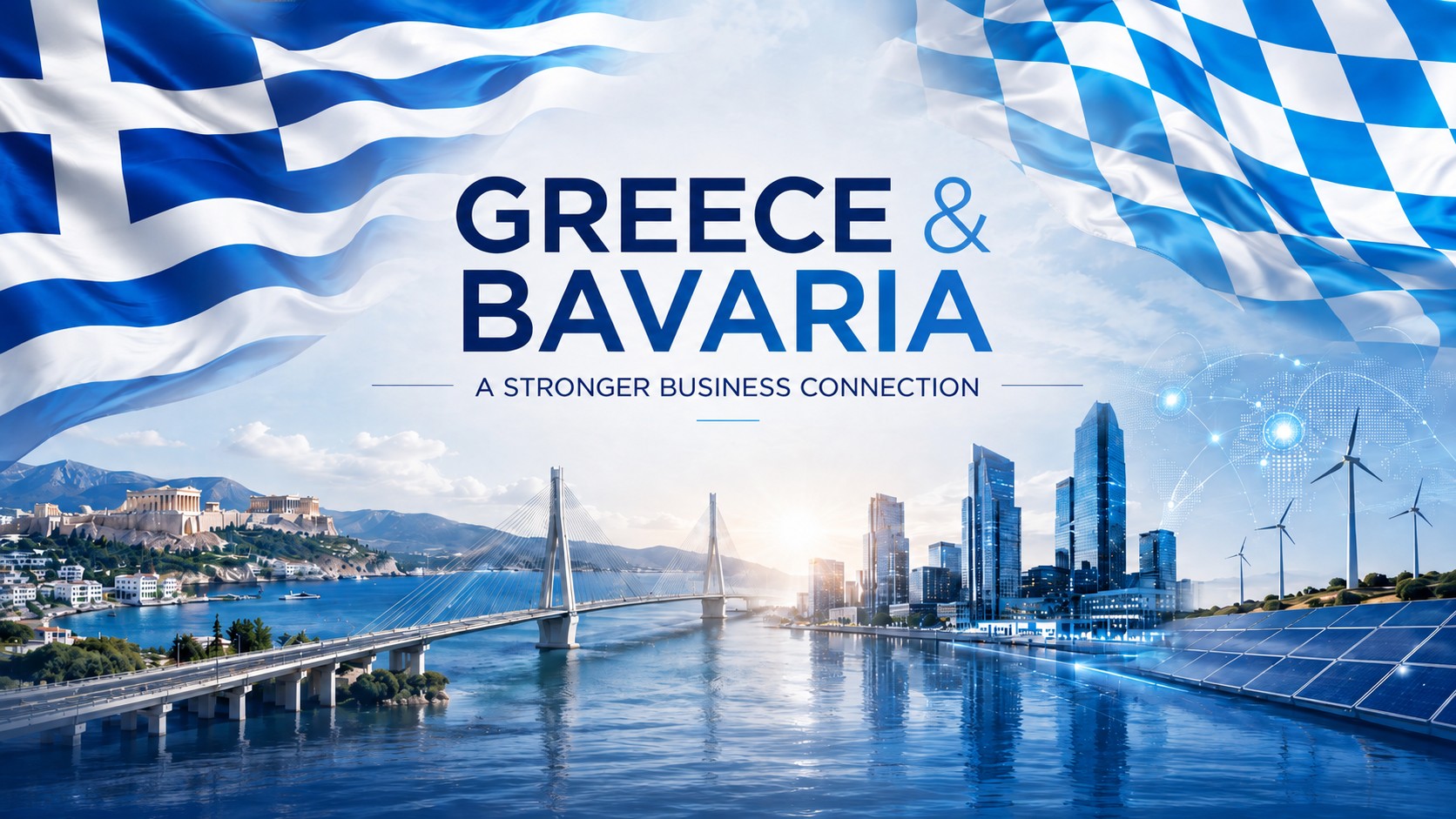
The Athens meeting between Greek Prime Minister Kyriakos Mitsotakis and Bavarian Minister-President Markus Söder on 30 July 2026 did not produce a headline investment agreement. No transaction value, signed memorandum, corporate project or implementation timetable was publicly announced. Its importance lies elsewhere: the meeting signalled that Greece and Bavaria are looking beyond their established commercial and tourism links towards energy, artificial intelligence, aerospace, defence technology and high-value services.
A broader agenda than the original visit programme
Before Söder arrived in Athens, the Bavarian government placed university cooperation in energy and hydrogen at the centre of the agenda. The official post-meeting communication went further, referring to Greek interest in AI, aerospace and European defence technology, the development of joint high-tech clusters and the expansion of strategic university partnerships. Mitsotakis and Söder’s public remarks were brief, but their direction was clear: both sides see scope for a more technology-oriented economic relationship.
The visit also reinforced a broader federal trend. On 4 May 2026, the foreign ministers of Greece and Germany agreed to work towards a Partnership for Strategic Cooperation. Its pillars include security and migration, defence and civil protection, economic cooperation and investment, digital transformation and infrastructure, as well as science, education and skills. Bavaria’s involvement adds industrial depth to that framework through its technology companies, universities, aerospace infrastructure and defence ecosystem.
Energy cooperation can move from research to deployment
Greece has become one of Southeast Europe’s most active energy-transition markets. Solar, wind and battery-storage deployment is expanding, electricity interconnections are being developed for the islands and offshore wind remains a significant future opportunity. The International Energy Agency notes the progress made in renewables and licensing reforms, while also underlining the continuing need for transparent regulation, faster spatial planning and timely project approvals.
Bavarian companies and research institutions could contribute engineering, industrial technology, energy-management software, storage integration, project development and hydrogen expertise. The commercial potential extends beyond power-generation assets. Grid services, maintenance, digital monitoring, energy efficiency and the decarbonisation of industrial facilities and buildings may offer more accessible entry points for specialised medium-sized companies.
The central challenge is project conversion. Political interest will only become investment when projects have secure grid access, credible permitting schedules, clear revenue models and dependable buyers. University partnerships can support research and pilot schemes, but projects also need industrial partners and commercial offtake from the beginning.
Space cooperation is no longer a theoretical prospect
Greece is building an operational space capability. Its National Small Satellite Programme is designed to comprise 13 satellites. Two high-resolution radar satellites were launched in November 2025, followed in May 2026 by four Hellenic Fire System satellites dedicated to detecting and tracking wildfires. The programme supports disaster management, environmental monitoring, maritime awareness, agriculture and national security.
Bavaria has positioned itself as a major European aerospace location, often described by its government as “Space Valley”. Its assets include the Technical University of Munich’s aerospace capabilities, Oberpfaffenhofen, Galileo-related expertise, system companies, suppliers and specialised technical-service providers.
This creates credible opportunities in Earth-observation analytics, wildfire and climate-risk monitoring, secure communications, optical technologies, satellite-ground integration and dual-use applications. Greece contributes operational use cases and a growing national programme; Bavaria contributes engineering depth, research infrastructure and access to established supply chains.
The gaps are mainly commercial and organisational. Greek technology firms need stronger routes into European aerospace supply chains, predictable procurement cycles and support with certification. Joint projects also require clear arrangements covering intellectual property, data access, consortium leadership and long-term maintenance.
Security is becoming an industrial cooperation field
Söder’s post-meeting communication specifically mentioned Greek interest in European defence technology. Bavaria describes itself as Germany’s leading defence-tech region, with around 200 relevant companies, approximately 50,000 employees and more than €9.5 billion in gross value added.
Greece offers a strategically important operating environment. Its maritime geography, EU and NATO responsibilities, external-border requirements and exposure to wildfires and other natural disasters create demand for surveillance, secure communications, resilient infrastructure and civil-protection technology. The May 2026 Greek–German strategic framework also explicitly covers defence procurement, logistics, crisis management and hybrid threats.
Potential cooperation areas include drones and counter-UAS systems, maritime situational awareness, satellite communications, cybersecurity, border technology, critical-infrastructure protection and dual-use artificial intelligence. Europe’s wider defence-investment cycle strengthens the commercial case: EU defence investment was forecast to approach €130 billion in 2025, with research and development spending projected at €17 billion.
These are not simple markets to enter. Companies must prepare for security clearances, export-control rules, technical certification, procurement interoperability and lengthy sales cycles. Smaller Greek and Bavarian firms will often need to participate through consortia or partnerships with established prime contractors.
Services are the biggest unfinished opportunity
The existing Greek–German commercial relationship is substantial. In 2025, Greek goods exports to Germany reached €3.7 billion, while imports from Germany reached €9.1 billion. Greek service receipts from Germany totalled approximately €5.2 billion, compared with €2.4 billion in payments to Germany. German companies are also among Greece’s principal foreign investors.
The service figures, however, require interpretation. Travel receipts from German visitors reached €3.8 billion in 2025, accounting for approximately 73% of all Greek service receipts from Germany. Greece’s services relationship with Germany is therefore large but still heavily concentrated in tourism.
The next opportunity is to expand business-to-business services. Greece can support Bavarian and German companies with multilingual customer operations, managed IT and cybersecurity, engineering support, recruitment, shared-service centres, financial administration, regional sales support and technical after-sales services.
Greece offers EU jurisdiction, multilingual professionals, improving infrastructure, competitive operating costs and access to Southeast European markets. Remaining constraints include shortages of ICT specialists and advanced digital skills, slow digital adoption among smaller businesses, regulatory friction and limited international awareness of Greece as a location for sophisticated corporate services.
The market now needs a pipeline, not only positive language
The Athens meeting created momentum, but the next phase should be practical. Greece and Bavaria would benefit from sector-specific business missions, university–industry consortia, an accessible pipeline of investment-ready projects and a permanent coordination channel for companies.
Söder’s visit should therefore be viewed as an opening signal. Greece is no longer presenting itself only as a tourism market, energy location or gateway to the Eastern Mediterranean. It is increasingly positioning itself as a European platform for technology, security, applied space services and specialised business operations.
The opportunity is credible. The remaining task is to convert political familiarity into projects, contracts, teams and long-term local presence.